
Don Quixote . Salvador Dali.
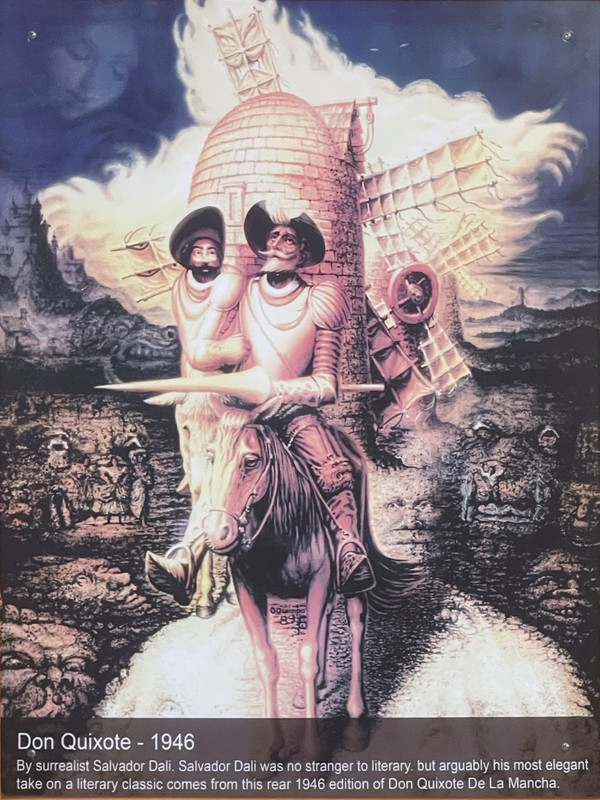
🎠 The Dreaming Knight · El Caballero Soñador
EN
In 1946, surrealist Salvador Dalí painted his own vision of Don Quixote de la Mancha. It was not merely illustration — it was a mirror. For Dalí, the knight of La Mancha was a reflection of the artist himself: a dreamer confronting absurd reality with imagination as his only weapon.
In this vision, windmills twist like memories; Dulcinea appears as a ghost of light; and the road becomes a river of time. Quixote and Sancho ride not through Spain, but through the landscape of the soul.
Dalí painted madness as devotion, and defeat as a form of faith. What we call illusion, he called purpose. And in that burning horizon, both he and the knight dissolve — not into failure, but into eternity.
ES
En 1946, el surrealista Salvador Dalí creó su propia visión de Don Quijote de la Mancha. No fue una simple ilustración — fue un espejo. Para Dalí, el caballero manchego era una proyección de sí mismo: un soñador que enfrentaba lo absurdo con la imaginación como única espada.
En su visión, los molinos se retuercen como recuerdos; Dulcinea flota como un fantasma de luz; y el camino se convierte en un río del tiempo. Don Quijote y Sancho cabalgan, no por Castilla, sino por el paisaje del alma.
Dalí pintó la locura como devoción y la derrota como una forma de fe. Lo que otros llaman ilusión, él lo llamó propósito. Y en aquel horizonte ardiente, él y el caballero se disuelven — no en el fracaso, sino en la eternidad.
“To dream in a world of logic is the highest form of rebellion.”
«Soñar en un mundo de lógica es la forma más alta de rebelión.»
— Pixelia.art · The Soul Archives


Comments
Post a Comment
🌠 A veces el universo responde cuando alguien escribe.